


Established in 1967 under the umbrella of the Ukrainian National Women’s League of America (UNWLA), the Lesia and Petro Kovaliv Fund continues a nearly six-decade tradition of recognizing outstanding contributions to Ukrainian literature.
Lesya and Petro Kovaliv, originally from central Ukraine, immigrated to Switzerland in the early 20th century. Their legacy lives on through the Kovaliv Fund, dedicated to nurturing and promoting Ukrainian poetry, prose, and nonfiction. Each year, a distinguished jury of respected Ukrainian writers and scholars selects awardees whose work advances Ukrainian intellectual and literary life.

Darya Tsymbalyuk
Ecocide in Ukraine: The Environmental Cost of Russia’s War (Polity, 2025)
Darya Tsymbalyuk — scholar, writer, and artist, and Assistant Professor at the University of Chicago — receives the 2025 Kovaliv Prize in Nonfiction / History for her groundbreaking book Ecocide in Ukraine: The Environmental Cost of Russia’s War.
Moving between scholarship, storytelling, and environmental witnessing, Tsymbalyuk examines the ecological devastation caused by Russia’s war and the ways in which war reshapes both ecosystems and the knowledge systems through which we understand them.
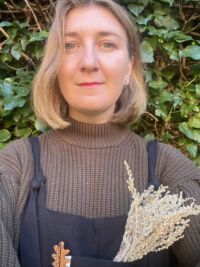
Dr. Daria Tsymbalyuk
[The book] is a powerful meditation on the fragility of life – human and other-than-human – amid ecological and epistemic devastation of our surrounding world. Moving between scholarship, storytelling, and environmental witnessing, Tsymbalyuk shows how war reshapes both ecosystems and the ways we know them. At a moment when academia seeks to grasp the mutual vulnerability of nature, culture, and knowledge, her work speaks urgently to a broader public reckoning with ecological loss and resilience. We could not have imagined a more fitting winner of this year’s Kovaliv Prize in Nonfiction/History.
—Oleh Kotsyuba, jury chair
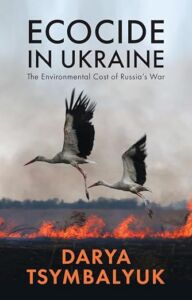
Ecocide in Ukraine: The Environmental Cost of Russia’s War, the brilliant work by Darya Tsymbalyuk, tells of the horrific ecological consequences of Russia’s war in Ukraine. Moving through the key themes that shape the narrative – water, land (zemlya), air, plants, bodies, and energy – the author reveals the murderous scale of the ecocide. The poetic quality of her style and the captivating stories of Ukraine’s natural world (did you know, for example, that the steppe may contain even greater biodiversity than tropical forests?) intertwine with the merciless reality of facts. These facts testify to the toxicity and destructiveness of war for an immense number of life forms – those living in the soil, on the ground, in the air, and in the water – as well as for local knowledge and the war-altered semiosis, where the sky becomes a threat, burrowing into the ground a form of protection, and a happy future is imagined as the chance to gather a new harvest of ripe, fragrant tomatoes under a gentle sun in one’s own garden.
—Maria Mayerchyk, jury member
Dariia Tsymbaliuk’s book is a discovery of sorts of eco-studies as an interdisciplinary field where scholarship and essayistic writing, diary and autobiography, law and a biological herbarium come together. This nonhierarchical writing is itself part of ecology, because it shows how polymorphic and multistylistic ecological thinking is. The writing itself—like everything Tsymbaliuk says about animate and inanimate nature, about the environment, and about people who are part of that very environment—becomes a document and a testimony of the war.
—Tamara Hundorova, jury member
Through the Kovaliv Prize, UNWLA reaffirms its enduring commitment to advancing Ukrainian literature and intellectual life. By honoring works that confront war, ecology, memory, and identity, the 2025 laureates embody the power of literature to document, challenge, and sustain a nation in times of profound transformation.